WELCOME

Thanks for visiting this blog. by visiting you have taken initiative to save our earth & natural resources. To contribute more effectively to save our earth & natural resources either you can mail to karucw@gmail.com or you yourself can add comment to the posts published.

MAY I HELP U

ADS

SOS Search Engine

Custom Search

Followers

Saturday, August 21, 2010

GLOBAL WARMING CAUSING THINING OF ICE IN ARCTIC

WHY THE ARCTIC BEING IS WATCHED UNDER A MICROSCOPE?
The Arctic has become the global warming’s victim. This region is found to be very sensitive and maximum affected by global warming. This has turned the attention of most scientists towards it. The scientists are analyzing the various effects of global warming on Arctic region. 
2. WHAT ARE THE EFFECTS THAT THE ARCTIC IS UNDERGOING NOW?
Compared to the various places in this globe, the average temperature in the Arctic region is doubling up. Due to this drastic temperature rise the Arctic ice is getting melted & becoming thin day by day. For instance, the largest single block of ice in the Arctic, the Ward Hunt Ice Shelf, has been unaffected for around 3,000 years before it started cracking in 2000. Less than 2 years it got spited, now it started even to break down into   pieces.
The total polar ice cap is contracting. From the images sent by satellites it’s crystal clear that the solid ice in Arctic region is melting at the rate of 9 percent per decade. If the same trend is maintained, by the end of the century one won’t be able to find ice in the Arctic region.
3. HOW WILL THE DRASTIC ICE MELT AFFECT THE ARCTIC?
The native people, wildlife and plants are already being affected this drastic melting of ice. When the Ward Hunt Ice Shelf broke, the extraordinary freshwater lake which was enclosed in it & its sole ecosystem drained into the ocean. Polar bears, whales, walrus and seals are altering their feeding and relocation patterns, thereby making it difficult for native people to hunt them. If this continues then the entire villages along Arctic coastlines has to be uprooted. This is due to the fear of getting flooded. Also the native people of the Arctic feel global warming as a greatest threat to their civilization and their survival.
4. WILL ARCTIC ICE MELT EFFECT BE FELT AWAY FROM THE POLAR REGION?
Yes -- the reduction in the Arctic ice cap is increasing global warming. Normally a shielding layer is formed over the Arctic region. This shielding layer is made up of snow and ice. When that shielding layer melts, there’s greater amount of sunlight absorbed by the earth there by becoming hotter.
Tremendous increase in the temperature has already affected the Alaska forest by increasing the growth of pests. These pests grow faster in warmer conditions. It was found that these pests have fed around 3.4 million acres of forest in one decade from 1993 to 2003.
Melting glaciers and land-based ice sheets has contributed to increment in the sea levels, bullying low-lying areas around the earth with beach erosion, coastal flooding, and contamination of freshwater supplies. Mainly the island nations are at greatest threat as more than half of their population lies in the region which is just 6 feet above the sea level, e.g. Maldives. Even few key cities like Shanghai and Lagos are likely to face similar problems.
 5. Can anything be done to halt global warming?
Yes. To generate electricity and power our vehicles, we gut fossil fuels like oil, coal and gas. This in turn produces the green house gases that cause global warming. The more we burn, the faster will be the rate of global warming. From this it’s clear that all we have to do is to conserve energy.
And we can do it. Technologies has improved allot today that make cars that run and burn less gas, generate electricity from wind and sun, modernize power plants, and build refrigerators, air conditioners and the  buildings that utilizes less power. This all can be more effective if every individual contributes his level in saving energy and thereby halting global warming.

Thursday, August 19, 2010

WEATHER GONA REMAIN UNCERTAIN DUE TO CLIMATE CHANGES

THIS YEAR THERE ARE GOING TO BE VARIOUS ADVERSE EFFECTS OF WEATHER ON THE ENVIRONMENT. ITS GOING TO BE VERY HARSH.
           FOR INSTANCE, THE FLOODS  WHICH RECENTLY TOOK PLACE IN ISLAMABAD, PAKISTAN IS VERY MUCH EXAMPLE OF ADVERSE EFFECT ON WEATHER, CREATED BY HUMANS, IN THE FORM OF GLOBAL WARMING BY EMITTING VARIOUS GREEN HOUSE GASES INTO ATMOSPHERE. THIS FLOOD TOKE THOUSANDS OF LIFE WEATHER THEY CONTRIBUTED TO GLOBAL WARMING OR NOT.
           ITS WAS FOUND THAT, CHINA TOPS THE PLACE IN EMITTING GREEN HOUSE GASES AFTER US. ALSO ITS BEING PREDICTED THAT THIS YEAR WOULD HAVE HOTTEST N COLDEST TEMPERATURES.
         IF THIS EMISSION OF GREEN HOUSE GASES IS NOT CURBED, THEN U WILL B ABLE TO SEE THOSE THINGS WHICH ARE OUT OF OUR IMAGINATION. SIMPLY DESTROY THE HUMAN LIFE IN FEW YEARS OR SO.
       SO WE HAVE TO SAVE OUR EARTH AND OUR SELF TOOO 


Monday, August 16, 2010

INCREÅSE IN WATER SÙRFÀCE-LAND SUBMERGES

As the earths temperature is increasing tremendously due to green house gases, the had caps of the mountains have started to melt. This in turn is cause increase in the water of various water bodies. When these excess water spreads out it submergers some portion of land depending on the amount of had being melted. More the melting more the water is formed and more land portion will submerge. This will cause shortage in land. At the same time the human population is increasing at a greater speed which in turn demands in increment in land requirement. So this goes on and on. Elimination of pollution is impossible, but it can be controlled. Its all in our hand. So let up put our hands together and rate our earth:-)

Thursday, August 12, 2010

THE TREES & VARIOUS LAWS RELATED TO THEM

there are various laws apart from those for robbery, corruption, etc. these laws are made to protect the trees. Many of them might not even know that there are laws to protect the trees. These are all due to lack of knowledge and awareness.

i would like to bring to awareness to the readers about the trees.

    * THE OVER HEAD PROBLEMS

    These are those problems those occur above the earths surface. For instance if the grows to high along with that if its branches are also wide spread it will have a collition with wires and many other materials. If for such reasons we cut them completely then it will in turn harm us. We should have the tendency of giving & taking in life, weather it be with people or trees. then only we can live our life with peace & harmony.

  * THE UNDER GROUND PROBLEM
`    These are the various problems that cannot be symptomless at the initial stages. Some tree grows more under the ground at various angles, length. Depending upon the depth the problem might arise. If these roots find any obstacles then comes the problem. these problems causes huge disaster then the overhead one.

    * Trees

    There are several laws that are imposed by Tree Prevention Orders. These includes various amounts of fine depending upon the crime the one has committed. The supreme court has imposed various laws to protect the trees. Strict action can be taken on the one because of whom the single tree has died or the whole area of trees are affected. These various laws to protect the trees can be suggested by anyone. The one who wants any law to be made in the favor of trees can approach the District Council. But the final decision is taken by Department of the Environment (DEFRA).
     
      Bushes, hedgerows and young trees doesn't come under this protection unless they belong to a rare species of form part of a Site of Special Scientific Interest (SSSI).

    For any tree to be fallen a license is required from the Forest Ministry, otherwise it is punishable offense.

Saturday, July 3, 2010

VIEWS ON GLOBAL WARMING


Total greenhouse gas emissions in 2000, including land-use change.
There are different views over what the appropriate policy response to climate change should be. These competing views weigh the benefits of limiting emissions of greenhouse gases against the costs. In general, it seems likely that climate change will impose greater damages and risks in poorer regions.

POLITICS

Developing and developed countries have made different arguments over who should bear the burden of costs for cutting emissions. Developing countries often concentrate on per capita emissions, that is, the total emissions of a country divided by its population. Per capita emissions in the industrialized countries are typically as much as ten times the average in developing countries. This is used to make the argument that the real problem of climate change is due to the profligate and unsustainable lifestyles of those living in rich countries. On the other hand, commentators from developed countries more often point out that it is total emissions that matter. In 2008, developing countries made up around half of the world's total emissions of CO2 from cement production and fossil fuel use.
 The Kyoto Protocol, which came into force in 2005, sets legally binding emission limitations for most developed countries. Developing countries are not subject to limitations. This exemption led the U.S. (under President George W. Bush) and a previous Australian Government to decide not to ratify the treaty. At the time, almost all world leaders expressed their disappointment over President Bush's decision. Australia has since ratified the Kyoto protocol.

PUBLIC OPINION

In 2007–2008 Gallup Polls surveyed 127 countries. Over a third of the world's population was unaware of global warming, with people in developing countries less aware than those in developed, and those in Africa the least aware. Of those aware, Latin America leads in belief that temperature changes are a result of human activities while Africa, parts of Asia and the Middle East, and a few countries from the Former Soviet Union lead in the opposite belief. In the Western world, opinions over the concept and the appropriate responses are divided. Nick Pigeon of Cardiff University finds that "results show the different stages of engagement about global warming on each side of the Atlantic"; where Europe debates the appropriate responses while the United States debates whether climate change is happening.

OTHER VIEWS

Most scientists accept that humans are contributing to observed climate change. National science academies have called on world leaders for policies to cut global emissions. There are, however, some scientists and non-scientists who question aspects of climate change science.
Organizations such as the libertarian Competitive Enterprise Institute, conservative commentators, and companies such as ExxonMobil have challenged IPCC climate change scenarios, funded scientists who disagree with the scientific consensus, and provided their own projections of the economic cost of stricter controls. Environmental organizations and public figures have emphasized changes in the current climate and the risks they entail, while promoting adaptation to changes in infrastructural needs and emissions reductions. Some fossil fuel companies have scaled back their efforts in recent years, or called for policies to reduce global warming.

UNFCCC


Most countries are Parties to the United Nations Framework Convention on Climate Change (UNFCCC). The ultimate objective of the Convention is to prevent "dangerous" human interference of the climate system. As is stated in the Convention, this requires that GHGs are stabilized in the atmosphere at a level where ecosystems can adapt naturally to climate change, food production is not threatened, and economic development can proceed in a sustainable fashion.
The UNFCCC recognizes differences among countries in their responsibility to act on climate change. In the Kyoto Protocol to the UNFCCC, most developed countries (listed in Annex I of the treaty) took on legally binding commitments to reduce their emissions. Policy measures taken in response to these commitments have reduced emissions. For many developing (non-Annex I) countries, reducing poverty is their overriding aim.
At the 15th UNFCCC Conference of the Parties, held in 2009 at Copenhagen, several UNFCCC Parties produced the Copenhagen Accord. Parties agreeing with the Accord aim to limit the future increase in global mean temperature to below 2 °C.

RESPONSES TO GLOBAL WARMING

Carbon capture and storage (CCS) is an approach to mitigation. Emissions may be sequestered from fossil fuel power plants, or removed during processing in hydrogen production. When used on plants, it is known as bio-energy with carbon capture and storage.
Reducing the amount of future climate change is called mitigation of climate change. The IPCC defines mitigation as activities that reduce greenhouse gas (GHG) emissions, or enhance the capacity of carbon sinks to absorb GHG’s from the atmosphere. Many countries, both developing and developed, are aiming to use cleaner, less polluting, technologies. Use of these technologies aids mitigation and could result in substantial reductions in CO2emissions. Policies include targets for emissions reductions, increased use of renewable energy, and increased energy efficiency. Studies indicate substantial potential for future reductions in emissions.
Other policy responses include adaptation to climate change. Adaptation to climate change may be planned, e.g., by local or national government, or spontaneous, i.e., done privately without government intervention. The ability to adapt (called "adaptive capacity") is closely linked to social and economic development. Even societies with high capacities to adapt are still vulnerable to climate change. Planned adaptation is already occurring on a limited basis. The barriers, limits, and costs of future adaptation are not fully understood.
Another policy response is engineering of the climate (geo engineering). This policy response is sometimes grouped together with mitigation. Geo engineering is largely unproven, and reliable cost estimates for it have not yet been published.

Carbon capture and storage (CCS) is an approach to mitigation. Emissions may be sequestered from fossil fuel power plants, or removed during processing in hydrogen production. When used on plants, it is known as bio-energy with carbon capture and storage.
Reducing the amount of future climate change is called mitigation of climate change. The IPCC defines mitigation as activities that reduce greenhouse gas (GHG) emissions, or enhance the capacity of carbon sinks to absorb GHG’s from the atmosphere. Many countries, both developing and developed, are aiming to use cleaner, less polluting, technologies. Use of these technologies aids mitigation and could result in substantial reductions in CO2emissions. Policies include targets for emissions reductions, increased use of renewable energy, and increased energy efficiency. Studies indicate substantial potential for future reductions in emissions.
Other policy responses include adaptation to climate change. Adaptation to climate change may be planned, e.g., by local or national government, or spontaneous, i.e., done privately without government intervention. The ability to adapt (called "adaptive capacity") is closely linked to social and economic development. Even societies with high capacities to adapt are still vulnerable to climate change. Planned adaptation is already occurring on a limited basis. The barriers, limits, and costs of future adaptation are not fully understood.
Another policy response is engineering of the climate (geo engineering). This policy response is sometimes grouped together with mitigation. Geo engineering is largely unproven, and reliable cost estimates for it have not yet been published.

ATTRIBUTED AND EXPECTED EFFECTS


Global warming may be detected in natural, ecological or social systems as a change having statistical significance. Attribution of these changes e.g., to natural or human activities, is the next step following detection.

NATURAL SYSTEMS

Sparse records indicate that glaciers have been retreating since the early 1800s. In the 1950s measurements began that allow the monitoring of glacial mass balance, reported to the WGMS and the NSIDC.
Global warming has been detected in a number of systems. Some of these changes, e.g., based on the instrumental temperature record, have been described in the section on temperature changes. Rising sea levels and observed decreases in snow and ice extent are consistent with warming. Most of the increase in global average temperature since the mid-20th century is, with high probability, attributable to human-induced changes in greenhouse gas concentrations.
Even with current policies to reduce emissions, global emissions are still expected to continue to grow over the coming decades. Over the course of the 21st century, increases in emissions at or above their current rate would very likely induce changes in the climate system larger than those observed in the 20th century.
In the IPCC Fourth Assessment Report, across a range of future emission scenarios, model-based estimates of sea level rise for the end of the 21st century (the year 2090-2099, relative to 1980-1999) range from 0.18 to 0.59 m. These estimates, however, were not given a likelihood due to a lack of scientific understanding, nor was an upper bound given for sea level rise. Over the course of centuries to millennia, the melting of ice sheets could result in sea level rise of 4–6 m or more.
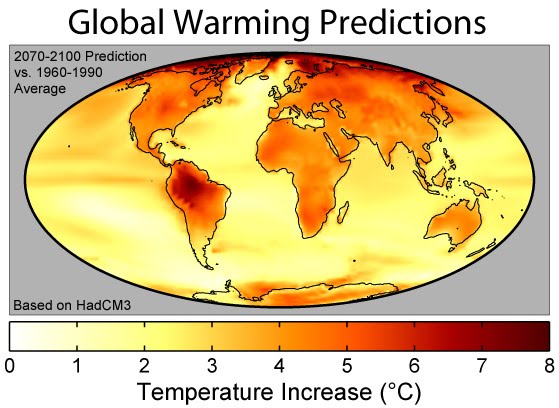
Changes in regional climate are expected to include greater warming over land, with most warming at high northern latitudes, and least warming over the Southern Ocean and parts of the North Atlantic Ocean. Snow cover area and sea ice extent are expected to decrease. The frequency of hot extremes, heat waves, and heavy precipitation will increase.

ECOLOGICAL SYSTEMS

In terrestrial ecosystems, the earlier timing of spring events, and pole ward and upward shifts in plant and animal ranges, has been linked with high confidence to recent warming. Future climate change is expected to particularly affect certain ecosystems, including tundra, mangroves, and coral reefs. It is expected that most ecosystems will be affected by higher atmospheric CO2 levels, combined with higher global temperatures. Overall, it is expected that climate change will result in the extinction of many species and reduced diversity of ecosystems.

SOCIAL SYSTEMS

There is some evidence of regional climate change affecting systems related to human activities, including agricultural and forestry management activities at higher latitudes in the Northern Hemisphere. Future climate change is expected to particularly affect some sectors and systems related to human activities. Water resources may be stressed in some dry regions at mid-latitudes, the dry tropics, and areas that depend on snow and ice melt. Reduced water availability may affect agriculture in low latitudes. Low-lying coastal systems are vulnerable to sea level rise and storm surge. It is expected that some regions will be particularly affected by climate change, including the Arctic, Africa, small islands, and Asian and African mega deltas. Some people, such as the poor, young children, and the elderly, are particularly at risk, even in high-income areas.

CLIMATE MODELS


Calculations of global warming prepared in or before 2001 from a range of climate models under the SRES A2 emissions scenario, which assumes no action is taken to reduce emissions and regionally divided economic development.

The geographic distribution of surface warming during the 21st century calculated by the HadCM3 climate model if a business as usual scenario is assumed for economic growth and greenhouse gas emissions. In this figure, the globally averaged warming corresponds to 3.0 °C (5.4 °F).
The main tools for projecting future climate changes are mathematical based on physical principles including fluid dynamics, thermodynamics and radiative transfer. Although they attempt to include as many processes as possible, simplifications of the actual climate system are inevitable because of the constraints of available computer power and limitations in knowledge of the climate system. All modern climate models are in fact combination of models for different parts of the Earth.     These include an atmospheric model for air movement, temperature, clouds, and other atmospheric properties; an ocean model that predicts temperature, salt content, and circulation of ocean waters; models for ice cover on land and sea; and a model of heat and moisture transfer from soil and vegetation to the atmosphere. Some models also include treatments of chemical and biological processes. Warming due to increasing levels of greenhouse gases is not an assumption of the models; rather, it is an end result from the interaction of greenhouse gases with radiative transfer and other physical processes. Although much of the variation in model outcomes depends on the greenhouse gas emissions used as inputs, the temperature effect of a specific greenhouse gas concentration (climate sensitivity) varies depending on the model used. The representation of clouds is one of the main sources of uncertainty in present-generation models.
Global climate model projections of future climate most often have used estimates of greenhouse gas emissions from the IPCC Special Report on Emissions Scenarios (SRES). In addition to human-caused emissions, some models also include a simulation of the carbon cycle; this generally shows a positive feedback, though this response is uncertain. Some observational studies also show a positive feedback. Including uncertainties in future greenhouse gas concentrations and climate sensitivity, the IPCC anticipates a warming of 1.1 °C to 6.4 °C (2.0 °F to 11.5 °F) by the end of the 21st century, relative to 1980–1999.
Models are also used to help investigate the causes of recent climate change by comparing the observed changes to those that the models project from various natural and human-derived causes. Although these models do not unambiguously attribute the warming that occurred from approximately 1910 to 1945 to either natural variation or human effects, they do indicate that the warming since 1970 is dominated by man-made greenhouse gas emissions.
The physical realism of models is tested by examining their ability to simulate current or past climates. Current climate models produce a good match to observations of global temperature changes over the last century, but do not simulate all aspects of climate. Not all effects of global warming are accurately predicted by the climate models used by the IPCC. For example, observed Arctic shrinkage has been faster than that predicted.

FEEDBACK


Feedback is a process in which changing one quantity changes a second quantity, and the change in the second quantity in turn changes the first. Positive feedback amplifies the change in the first quantity while negative feedback reduces it. Feedback is important in the study of global warming because it may amplify or diminish the effect of a particular process. The main positive feedback in global warming is the tendency of warming to increase the amount of water vapor in the atmosphere, a significant greenhouse gas. The main negative feedback is radiative cooling, which increases as the fourth power of temperature; the amount of heat radiated from the Earth into space increases with the temperature of Earth's surface and atmosphere. Imperfect understanding of feedbacks is a major cause of uncertainty and concern about global warming.

SOLAR VARIATION


Solar variation over the last thirty years.
Variations in solar output have been the cause of past climate changes. The consensus among climate scientists is that changes in solar forcing probably had a slight cooling effect in recent decades. This result is less certain than some others, with a few papers suggesting a warming effect.
Greenhouse gases and solar forcing affect temperatures in different ways. While both increased solar activity and increased greenhouse gases are expected to warm the troposphere, an increase in solar activity should warm the stratosphere while an increase in greenhouse gases should cool the stratosphere. Observations show that temperatures in the stratosphere have been cooling since 1979, when satellite measurements became available. Radiosonde (weather balloon) data from the pre-satellite era show cooling since 1958, though there is greater uncertainty in the early radiosonde record.
A related hypothesis, proposed by Henrik Svensmark, is that magnetic activity of the sun deflects cosmic rays that may influence the generation of cloud condensation nuclei and thereby affect the climate. Other research has found no relation between warming in recent decades and cosmic rays. A recent study concluded that the influence of cosmic rays on cloud cover is about a factor of 100 lower than needed to explain the observed changes in clouds or to be a significant contributor to present-day climate change.

AEROSOLS AND SOOT


Ship tracks over the Atlantic Ocean on the east coast of the United States. The climatic impacts from aerosol forcing could have a large effect on climate through the indirect effect.
Global dimming, a gradual reduction in the amount of global direct irradiance at the Earth's surface, has partially counteracted global warming from 1960 to the present. The main cause of this dimming is aerosols produced by volcanoes and pollutants. These aerosols exert a cooling effect by increasing the reflection of incoming sunlight. The effects of the products of fossil fuel combustion—CO2 and aerosols—have largely offset one another in recent decades, so that net warming has been due to the increase in non-CO2 greenhouse gases such as methane.
In addition to their direct effect by scattering and absorbing solar radiation, aerosols have indirect effects on the radiation budget. Sulfate aerosols act as cloud condensation nuclei and thus lead to clouds that have more and smaller cloud droplets. These clouds reflect solar radiation more efficiently than clouds with fewer and larger droplets. This effect also causes droplets to be of more uniform size, which reduces growth of raindrops and makes the cloud more reflective to incoming sunlight. Indirect effects are most noticeable in marine stratiform clouds, and have very little radiative effect on convective clouds.
Soot may cool or warm the surface, depending on whether it is airborne or deposited. Atmospheric soot aerosols directly absorb solar radiation, which heats the atmosphere and cools the surface. In isolated areas with high soot production, such as rural India, as much as 50% of surface warming due to greenhouse gases may be masked by atmospheric brown clouds. Atmospheric soot always contributes additional warming to the climate system. When deposited, especially on glaciers or on ice in arctic regions, the lower surface albedo can also directly heat the surface. The influences of aerosols, including black carbon, are most pronounced in the tropics and sub-tropics, particularly in Asia, while the effects of greenhouse gases are dominant in the extra tropics and southern hemisphere.

BANNER

SAVE OUR EARTH

Facebook

My Facebook Login Page
Login with Facebook

Popular Posts