WELCOME

Thanks for visiting this blog. by visiting you have taken initiative to save our earth & natural resources. To contribute more effectively to save our earth & natural resources either you can mail to karucw@gmail.com or you yourself can add comment to the posts published.

MAY I HELP U

ADS

SOS Search Engine

Custom Search

Followers

Saturday, July 3, 2010

ATTRIBUTED AND EXPECTED EFFECTS


Global warming may be detected in natural, ecological or social systems as a change having statistical significance. Attribution of these changes e.g., to natural or human activities, is the next step following detection.

NATURAL SYSTEMS

Sparse records indicate that glaciers have been retreating since the early 1800s. In the 1950s measurements began that allow the monitoring of glacial mass balance, reported to the WGMS and the NSIDC.
Global warming has been detected in a number of systems. Some of these changes, e.g., based on the instrumental temperature record, have been described in the section on temperature changes. Rising sea levels and observed decreases in snow and ice extent are consistent with warming. Most of the increase in global average temperature since the mid-20th century is, with high probability, attributable to human-induced changes in greenhouse gas concentrations.
Even with current policies to reduce emissions, global emissions are still expected to continue to grow over the coming decades. Over the course of the 21st century, increases in emissions at or above their current rate would very likely induce changes in the climate system larger than those observed in the 20th century.
In the IPCC Fourth Assessment Report, across a range of future emission scenarios, model-based estimates of sea level rise for the end of the 21st century (the year 2090-2099, relative to 1980-1999) range from 0.18 to 0.59 m. These estimates, however, were not given a likelihood due to a lack of scientific understanding, nor was an upper bound given for sea level rise. Over the course of centuries to millennia, the melting of ice sheets could result in sea level rise of 4–6 m or more.
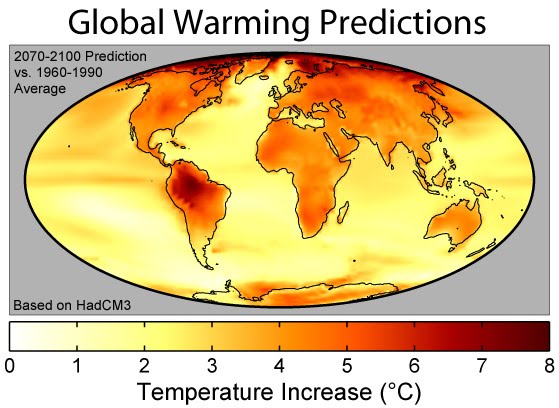
Changes in regional climate are expected to include greater warming over land, with most warming at high northern latitudes, and least warming over the Southern Ocean and parts of the North Atlantic Ocean. Snow cover area and sea ice extent are expected to decrease. The frequency of hot extremes, heat waves, and heavy precipitation will increase.

ECOLOGICAL SYSTEMS

In terrestrial ecosystems, the earlier timing of spring events, and pole ward and upward shifts in plant and animal ranges, has been linked with high confidence to recent warming. Future climate change is expected to particularly affect certain ecosystems, including tundra, mangroves, and coral reefs. It is expected that most ecosystems will be affected by higher atmospheric CO2 levels, combined with higher global temperatures. Overall, it is expected that climate change will result in the extinction of many species and reduced diversity of ecosystems.

SOCIAL SYSTEMS

There is some evidence of regional climate change affecting systems related to human activities, including agricultural and forestry management activities at higher latitudes in the Northern Hemisphere. Future climate change is expected to particularly affect some sectors and systems related to human activities. Water resources may be stressed in some dry regions at mid-latitudes, the dry tropics, and areas that depend on snow and ice melt. Reduced water availability may affect agriculture in low latitudes. Low-lying coastal systems are vulnerable to sea level rise and storm surge. It is expected that some regions will be particularly affected by climate change, including the Arctic, Africa, small islands, and Asian and African mega deltas. Some people, such as the poor, young children, and the elderly, are particularly at risk, even in high-income areas.

CLIMATE MODELS


Calculations of global warming prepared in or before 2001 from a range of climate models under the SRES A2 emissions scenario, which assumes no action is taken to reduce emissions and regionally divided economic development.

The geographic distribution of surface warming during the 21st century calculated by the HadCM3 climate model if a business as usual scenario is assumed for economic growth and greenhouse gas emissions. In this figure, the globally averaged warming corresponds to 3.0 °C (5.4 °F).
The main tools for projecting future climate changes are mathematical based on physical principles including fluid dynamics, thermodynamics and radiative transfer. Although they attempt to include as many processes as possible, simplifications of the actual climate system are inevitable because of the constraints of available computer power and limitations in knowledge of the climate system. All modern climate models are in fact combination of models for different parts of the Earth.     These include an atmospheric model for air movement, temperature, clouds, and other atmospheric properties; an ocean model that predicts temperature, salt content, and circulation of ocean waters; models for ice cover on land and sea; and a model of heat and moisture transfer from soil and vegetation to the atmosphere. Some models also include treatments of chemical and biological processes. Warming due to increasing levels of greenhouse gases is not an assumption of the models; rather, it is an end result from the interaction of greenhouse gases with radiative transfer and other physical processes. Although much of the variation in model outcomes depends on the greenhouse gas emissions used as inputs, the temperature effect of a specific greenhouse gas concentration (climate sensitivity) varies depending on the model used. The representation of clouds is one of the main sources of uncertainty in present-generation models.
Global climate model projections of future climate most often have used estimates of greenhouse gas emissions from the IPCC Special Report on Emissions Scenarios (SRES). In addition to human-caused emissions, some models also include a simulation of the carbon cycle; this generally shows a positive feedback, though this response is uncertain. Some observational studies also show a positive feedback. Including uncertainties in future greenhouse gas concentrations and climate sensitivity, the IPCC anticipates a warming of 1.1 °C to 6.4 °C (2.0 °F to 11.5 °F) by the end of the 21st century, relative to 1980–1999.
Models are also used to help investigate the causes of recent climate change by comparing the observed changes to those that the models project from various natural and human-derived causes. Although these models do not unambiguously attribute the warming that occurred from approximately 1910 to 1945 to either natural variation or human effects, they do indicate that the warming since 1970 is dominated by man-made greenhouse gas emissions.
The physical realism of models is tested by examining their ability to simulate current or past climates. Current climate models produce a good match to observations of global temperature changes over the last century, but do not simulate all aspects of climate. Not all effects of global warming are accurately predicted by the climate models used by the IPCC. For example, observed Arctic shrinkage has been faster than that predicted.

FEEDBACK


Feedback is a process in which changing one quantity changes a second quantity, and the change in the second quantity in turn changes the first. Positive feedback amplifies the change in the first quantity while negative feedback reduces it. Feedback is important in the study of global warming because it may amplify or diminish the effect of a particular process. The main positive feedback in global warming is the tendency of warming to increase the amount of water vapor in the atmosphere, a significant greenhouse gas. The main negative feedback is radiative cooling, which increases as the fourth power of temperature; the amount of heat radiated from the Earth into space increases with the temperature of Earth's surface and atmosphere. Imperfect understanding of feedbacks is a major cause of uncertainty and concern about global warming.

SOLAR VARIATION


Solar variation over the last thirty years.
Variations in solar output have been the cause of past climate changes. The consensus among climate scientists is that changes in solar forcing probably had a slight cooling effect in recent decades. This result is less certain than some others, with a few papers suggesting a warming effect.
Greenhouse gases and solar forcing affect temperatures in different ways. While both increased solar activity and increased greenhouse gases are expected to warm the troposphere, an increase in solar activity should warm the stratosphere while an increase in greenhouse gases should cool the stratosphere. Observations show that temperatures in the stratosphere have been cooling since 1979, when satellite measurements became available. Radiosonde (weather balloon) data from the pre-satellite era show cooling since 1958, though there is greater uncertainty in the early radiosonde record.
A related hypothesis, proposed by Henrik Svensmark, is that magnetic activity of the sun deflects cosmic rays that may influence the generation of cloud condensation nuclei and thereby affect the climate. Other research has found no relation between warming in recent decades and cosmic rays. A recent study concluded that the influence of cosmic rays on cloud cover is about a factor of 100 lower than needed to explain the observed changes in clouds or to be a significant contributor to present-day climate change.

AEROSOLS AND SOOT


Ship tracks over the Atlantic Ocean on the east coast of the United States. The climatic impacts from aerosol forcing could have a large effect on climate through the indirect effect.
Global dimming, a gradual reduction in the amount of global direct irradiance at the Earth's surface, has partially counteracted global warming from 1960 to the present. The main cause of this dimming is aerosols produced by volcanoes and pollutants. These aerosols exert a cooling effect by increasing the reflection of incoming sunlight. The effects of the products of fossil fuel combustion—CO2 and aerosols—have largely offset one another in recent decades, so that net warming has been due to the increase in non-CO2 greenhouse gases such as methane.
In addition to their direct effect by scattering and absorbing solar radiation, aerosols have indirect effects on the radiation budget. Sulfate aerosols act as cloud condensation nuclei and thus lead to clouds that have more and smaller cloud droplets. These clouds reflect solar radiation more efficiently than clouds with fewer and larger droplets. This effect also causes droplets to be of more uniform size, which reduces growth of raindrops and makes the cloud more reflective to incoming sunlight. Indirect effects are most noticeable in marine stratiform clouds, and have very little radiative effect on convective clouds.
Soot may cool or warm the surface, depending on whether it is airborne or deposited. Atmospheric soot aerosols directly absorb solar radiation, which heats the atmosphere and cools the surface. In isolated areas with high soot production, such as rural India, as much as 50% of surface warming due to greenhouse gases may be masked by atmospheric brown clouds. Atmospheric soot always contributes additional warming to the climate system. When deposited, especially on glaciers or on ice in arctic regions, the lower surface albedo can also directly heat the surface. The influences of aerosols, including black carbon, are most pronounced in the tropics and sub-tropics, particularly in Asia, while the effects of greenhouse gases are dominant in the extra tropics and southern hemisphere.

Tuesday, June 29, 2010

GREENHOUSE EFFECT

The greenhouse effect is the process by which absorption and emission of infrared radiation by gases in the atmosphere are purported to warm a planet's lower atmosphere and surface. It was proposed by Joseph Fourier in 1824 and was first investigated quantitatively by Svante Arrhenius in 1896. The question in terms of global warming is how the strength of the presumed greenhouse effect changes when human activity increases the concentrations of greenhouse gases in the atmosphere.
Naturally occurring greenhouse gases have a mean warming effect of about 33 °C (59 °F). The major greenhouse gases are water vapor, which causes about 36–70 percent of the greenhouse effect; carbon dioxide (CO2), which causes 9–26 percent; methane (CH4), which causes 4–9 percent; and ozone (O3), which causes 3–7 percent. Clouds also affect the radiation balance, but they are composed of liquid water or ice and so have different effects on radiation from water vapor.
Human activity since the Industrial Revolution has increased the amount of greenhouse gases in the atmosphere, leading to increased radiative forcing from CO2, methane, tropospheric ozone, CFCs and nitrous oxide. The concentrations of CO2and methane have increased by 36% and 148% respectively since 1750. These levels are much higher than at any time during the last 650,000 years, the period for which reliable data has been extracted from ice cores. Less direct geological evidence indicates that CO2 values higher than this were last seen about 20 million years ago. Fossil fuel burning has produced about three-quarters of the increase in CO2 from human activity over the past 20 years. Most of the rest is due to land-use change, particularly deforestation.
CO2 emissions are continuing to rise due to the burning of fossil fuels and land-use change. Estimates of changes in future emission levels of greenhouse gases have been made, and are called "emissions scenarios." The future level of emissions will depend on uncertain economic, sociological, technological, and natural developments. In most scenarios, emissions continue to rise over the century, while in a few, emissions are reduced. These emission scenarios, combined with carbon cycle modeling, have been used to produce estimates of how atmospheric concentrations of greenhouse gases will change in the future. Using the six IPCC SRES "marker" scenarios, models suggest that by the year 2100, the atmospheric concentration of CO2 could range between 541 and 970 ppm. This is an increase of 90-250% above the concentration in the year 1750. Fossil fuel reserves are sufficient to reach these levels and continue emissions past 2100 if coal, tar sands or methane clathrates are extensively exploited.
The destruction of stratospheric ozone by chlorofluorocarbons is sometimes mentioned in relation to global warming. Although there are a few areas of linkage, the relationship between the two is not strong. Reduction of stratospheric ozone has a cooling influence, but substantial ozone depletion did not occur until the late 1970s. Ozone in the troposphere (the lowest part of the Earth's atmosphere) does contribute to surface warming. 

MONTHLY CO2 MEASUREMENTS


Recent atmospheric carbon dioxide (CO2) increases. Monthly Co2 measurements display seasonal oscillations in overall yearly uptrend; each year's maximum occurs during the Northern Hemisphere's late spring, and declines during its growing season as plants remove some atmospheric CO2.

GREENHOUSE GASES

Greenhouse effect schematic showing energy flows between space, the atmosphere, and earth's surface. Energy exchanges are expressed in watts per square meter (W/m2).

EXTERNAL FORCINGS

External forcing refers to processes external to the climate system (though not necessarily external to Earth) that influence climate. Climate responds to several types of external forcing, such as radiative forcing due to changes in atmospheric composition (mainly greenhouse gas concentrations), changes in solar luminosity, volcanic eruptions, and variations in Earth's orbit around the Sun. Attribution of recent climate change focuses on the first three types of forcing. Orbital cycles vary slowly over tens of thousands of years and thus are too gradual to have caused the temperature changes observed in the past century.

BANNER

SAVE OUR EARTH

Facebook

My Facebook Login Page
Login with Facebook

Popular Posts